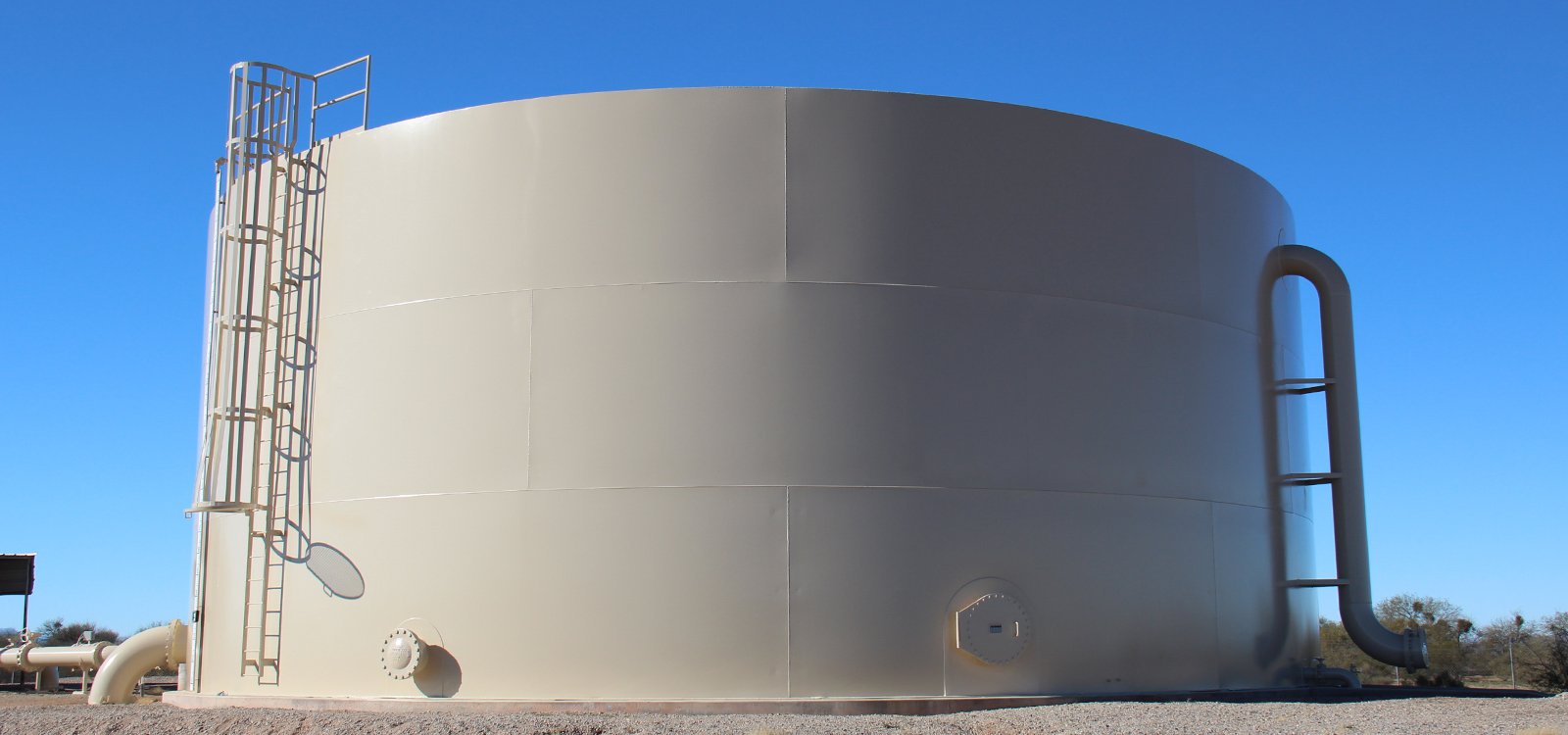
WATER-STORAGE-TANK
COATING REGULATIONS
Heightened environmental-protection concerns and
enforcement of regulations are compelling specifying
engineers, water-storage-tank owners and suppliers to be
aware of the legal limitations and liabilities concerning
the removal and application of coating systems to the
inside of water-storage tanks.
Removal methods: State and local EPA
air-quality regulations have increased the legal risk of
using silica sand for abrasive blasting. In addition, the
Clean Air Act currently sets forth as its compliance
level that not more than an average of 1.5 micrograms per
cubic meter of lead may exist in the atmosphere, averaged
over a 90-day period. The National Ambient Air Quality
Standard further sets forth a compliance level that not
more than 150 micrograms per cubic meter of particulate
matter less than 10 microns (PM) in size can be present
in the atmosphere, averaged during a 24-hour period. The
possibility of health-related lawsuits based on these
regs have made open blasting a practice of the past and
has made new blast abrasives and creative containment
methods necessary.
Tests and records
Following an abrasive-blasting project, the blast debris
must be tested to determine whether or not it is
hazardous. Four random samples are taken and tested in
accordance with EPA's Toxicity Characteristics Leaching
Procedure. When debris from a lead-paint removal project
has been characterized as a hazardous material, the lead
must be stabilized or extracted prior to disposal.
Hazardous-waste hauling requires extensive documentation,
since the tank owner is responsible for the debris
forever. Keeping a complete "paper trail" is
important to significantly reducing potential liability.
Coating: ANSI/NSF Standard 61 is a
testing and listing process dealing with indirect
additives that may contaminate drinking water. It seeks
to establish minimum requirements for control of
potential adverse health effects from products in contact
with water. This includes leaching of contaminants into
the water system.
Most state regulatory agencies have adopted or are in the
process of adopting NSF standards and can provide
information on approved coatings.
Rules governing allowable levels of solvent emission of
volatile organic compounds (VOCs) vary from state to
state. The federal EPA has left establishment of VOC
requirements to the states but recommends a level of 3.5
pounds of VOCs per gallon of coating. Those that do not
appear to meet these criteria include solvent-based
vinyls, conventional alkyds, and epoxy and polyure-thane
coatings with relatively low solids content. Compliant
coatings are mostly high-solids, conventional, powder
coatings, solvent-based materials or water-based
coatings.
VOC enforcement seems to depend on the extent of
compliance with clean-air standards in each area.
Currently restricted areas include portions of
California; metropolitan New York and New Jersey; and
counties in Arizona, Illinois, Kentucky, and Kansas.
The whole water-storage industry has been affected by
environmental restrictions. Awareness of the regs has
become an integral part of doing business.
Information about currently certified coatings can be
obtained by calling the National Sanitation Foundation
(NSF) at (313) 769-8010. For information on a
computerized update system, call the NSF electronic
access coordinator at (317) 769-5480.
This feature is an update of "New Regulations
Affecting the Painting of Water Tanks," presented by
William E. Daugherty at the Ohio AWWA section meeting in
Cincinnati, September 16, 1993.
|